


IMARC Group has recently released a new research study titled "United States Steel Market Report by Type (Flat Steel, Long Steel), Product (Structural Steel, Prestressing Steel, Bright Steel, Welding Wire and Rod, Iron Steel Wire, Ropes, Braids), Application (Building and Construction, Electrical Appliances, Metal Products, Automotive, Transportation, Mechanical Equipment, Domestic Appliances), and Region 2026-2034", offering a detailed analysis of the market drivers, segmentation, growth opportunities, trends, and competitive landscape to understand the current and future market scenarios.
United States Steel Market Size & Share 2026-2034
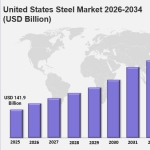
The United States steel market size reached USD 141.9 Billion in 2025 and is projected to reach USD 164.9 Billion by 2034, exhibiting a growth rate (CAGR) of 1.60% during 2026-2034. The thriving oil and gas industry, as it requires steel products for infrastructure development and operational activities, rising demand for autonomous vehicles, and ongoing advancements in technology are expanding the growth of the market in the country.
Key Market Statistics at a Glance
- Base Year: 2025
- Historical Years: 2020-2025
- Forecast Period: 2026-2034
- Market Size (2025): USD 141.9 Billion
- Projected Market Size (2034): USD 164.9 Billion
- Growth Rate: CAGR of 1.60% (2026-2034)
Explore Opportunities in the United States Steel Market: Download the IMARC Sample Report: https://www.imarcgroup.com/united-states-steel-market/requestsample
Key Growth Drivers and Trends in the United States Steel Market
Growth in the United States steel market is being driven by growing demand for autonomous vehicles, as production of these vehicles rises and requires strong structural components and safety features usually made from steel. Autonomous vehicles prioritize lightweight and high-strength materials to improve fuel efficiency and adhere to safety regulations, with Advanced High-Strength Steel (AHSS) and Ultra-High Strength Steel (UHSS) preferred due to their excellent strength-to-weight ratios. According to IMARC Group's report, the United States autonomous vehicle market is projected to exhibit a growth rate (CAGR) of 28.6% during 2024-2032, driving innovation and demand for specialized steel products.
One of the leading United States steel market trends is the thriving oil and gas industry, as construction of pipelines for transporting oil and natural gas involves huge steel utilization, used in pipes themselves as well as structures like pumping stations and tanks. Processes used in acquiring oil and gas involve steel alloys that can handle pressures and are highly resistant to corrosion and heat, increasing the necessity to develop new, high-performance steel products. As per IMARC Group's report, the United States oil and gas market size is projected to exhibit a growth rate (CAGR) of 4.60% during 2024-2032.
Another key factor supporting United States steel market growth is technological innovations, as continuous advancements in metallurgy and casting revolutionize steel production, enhancing quality and uniformity while helping key players adhere to stringent standards. Technologies like electric arc furnaces and cleaner energy sources help reduce carbon emissions and environmental impact, while IoT and data analytics improve supply chain management and overall efficiency. In 2023, US Steel Corporation launched a new electrical steel line with a ribbon cutting in Osceola, Arkansas.
Speak to an Analyst: https://www.imarcgroup.com/request?type=report&id=10697&flag=C
United States Steel Industry Segmentation Insights
Breakup by Type:
- Flat Steel: Serves as a primary material for frameworks, roofs, facades, and flooring systems in construction, and is extensively used in the automotive industry for vehicle bodies, chassis components, and interior and exterior parts.
- Long Steel: Includes reinforcing bars, beams, rods, and structural sections used in constructing bridges, highways, and buildings, with demand remaining high due to continuous urbanization and infrastructural development.
Breakup by Product:
- Structural Steel: Used in construction of civil structures such as buildings and bridges due to its durability and high strength-to-weight ratio, facilitating effective load-supporting designs.
- Prestressing Steel: Available as steel strands or bars used for concrete structures like bridges, highways, buildings, and parking lots, improving durability and reducing maintenance needs.
- Bright Steel: Preferred in automotive, aerospace, construction, and manufacturing industries requiring tight tolerances, including bars, rods, wire, and tubes value-added through cold drawing, grinding, or polishing.
- Welding Wire and Rod: Essential for fabrication and joining processes across construction and manufacturing applications.
- Iron Steel Wire: Used across a range of industrial and construction applications requiring durable wire products.
- Ropes: Supports industrial lifting, marine, and construction applications requiring high tensile strength.
- Braids: Used in specialized industrial and mechanical applications requiring flexible steel components.
Breakup by Application:
- Building and Construction: Used for a wide range of applications ranging from skyscrapers and bridges to residential homes, due to steel's versatility, strength, and recyclability supporting sustainability goals.
- Electrical Appliances: Utilizes steel across components including outer casings, internal frames, and panels for refrigerators, stoves, dishwashers, and washing machines.
- Metal Products: Includes pipes and tubes, sheets, bars, and rods used in construction, automobile, electronics, and various consumer products.
- Automotive: Drives demand for lightweight, high-strength steel supporting vehicle manufacturing, including AHSS and UHSS for autonomous and conventional vehicles.
- Transportation: Includes steel used in broader transportation infrastructure and rail applications.
- Mechanical Equipment: Supports manufacturing of industrial machinery and equipment components.
- Domestic Appliances: Covers steel used in household appliance manufacturing.
Breakup by Region:
- Northeast: At the forefront of industrial development and urbanization, with major metropolitan areas like New York City, Philadelphia, Boston, and Pittsburgh long serving as centers of manufacturing, construction, and infrastructure development.
- Midwest: Benefits from strategic location enabling efficient transportation of raw materials and finished steel products through waterways, railways, and highways, supported by a skilled workforce with deep steel manufacturing expertise.
- South: States including Texas, Louisiana, and Alabama have historically been hubs for heavy industry, benefiting from strategic geographic advantages including access to ports, railways, and interstate highways.
- West: Reflects steady demand supported by growing infrastructure and industrial development.
Key Challenges and Growth Opportunities in the United States Steel Market
The United States steel market faces challenges including stringent environmental rules, which impact production practices and require continued compliance investment. Raw material price volatility and the need for continued technological upgrades also present ongoing challenges for market participants.
Despite these challenges, the market offers considerable growth opportunities driven by the development of advanced steel products that offer higher efficiency, continued growth in autonomous vehicle production, and sustained demand from the oil and gas industry. Investment in decarbonization technologies such as electric arc furnaces and cleaner energy sources are expected to create substantial opportunities for long-term growth in the United States steel market.
Competitive Landscape
Many United States steel companies are expanding production capacities to diversify revenue streams while undertaking initiatives to reduce environmental impact through sustainable practices and product innovations. Key players are forming partnerships or mergers to strengthen market position, streamlining supply chains to improve logistics, and embracing digital technologies such as automation, data analytics, and IoT for improved operations. In 2023, ABB launched a new report considering carbon capture, hydrogen, and electrochemistry as routes to decarbonizing primary steel production, spotlighting innovative technology developments in the US, Brazil, China, and India.
Recent Developments in the United States Steel Market
- December 18, 2023: Nippon Steel Corporation (NSC) acquired United States Steel Corporation in an all-cash transaction at $55.00 per share, enhancing its world-leading manufacturing and technology capabilities and expanding the geographic areas it can serve.
- September 14, 2023: Transmute, a leader in supply chain data management and visibility solutions, announced the successful conclusion of its Steel Tech Demo technology test with United States Customs and Border Protection (US CBP).
Author IMARC Group
IMARC Group is a leading global market research company providing data-driven insights and expert consulting services to businesses seeking to achieve their strategic objectives. With a multidisciplinary team of industry experts, IMARC delivers reliable market intelligence across sectors including Chemicals and Materials, Healthcare, Technology, Agriculture, and Retail.
Contact Us:
IMARC Group
Email: sales@imarcgroup.com
United States: +1-201-971-6302