
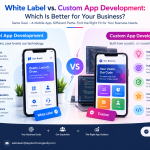

In today's digital-first business environment, having a mobile application is no longer just an additional advantage. It has become an important way to connect with customers, improve business operations, and create new revenue opportunities. Whether you run a startup, an established company, or an expanding enterprise, investing in app development can help you stay competitive.
However, before starting your app development journey, there is one important decision to make: Should you choose white label app development or invest in a custom-built application?
Both approaches offer valuable benefits, but they serve different business requirements. White label solutions are known for faster launches and lower initial investments, while custom applications provide greater flexibility, control, and opportunities for innovation.
So, which option is actually better for your business? Let's explore the differences and understand how to make the right decision.
What Is White Label App Development?
White label app development company involves using an already-developed application created by a third-party provider and customizing it with your company's branding. This usually includes adding your logo, business name, brand colors, and other visual elements to make the application look like your own product.
The main advantage is that you don't have to build everything from the beginning. The underlying application, core features, and technical infrastructure are already available.
For example, a restaurant business looking to launch an online food ordering application can choose a ready-made white label solution. Instead of spending months developing ordering, payment, and delivery management features, the business can customize an existing platform and launch much sooner.
Key benefits of white label app development:
- Faster market entry: Existing technology helps businesses launch without lengthy development cycles.
- Lower initial investment: Development expenses are generally lower because the core application is already built.
- Ready-to-use functionality: Essential features and standard workflows are often included.
- Simplified maintenance: The provider usually manages platform updates, bug fixes, and technical support.
- Brand customization: Businesses can establish their own identity through logos, colors, and selected design changes.
White label development is particularly useful for businesses that need a functional application quickly without building a dedicated development team.
What Is Custom App Development?
Custom app development is the process of creating an application specifically around your business objectives, customer expectations, and operational requirements.
Unlike white label solutions, custom applications are developed according to your preferred functionality, design, workflows, and technology requirements. Every element can be planned to support the way your business operates.
For instance, imagine a healthcare company that needs an application with appointment scheduling, patient dashboards, secure communication, customized reporting, and integration with existing hospital management systems. A standard white label application might not provide everything required. Custom development allows the company to build these features according to its specific needs.
Key benefits of custom app development:
- Complete flexibility: You can create features and workflows that match your business model.
- Unique user experience: Custom interfaces help create a recognizable and consistent brand experience.
- Greater control: You have more control over development priorities, technical decisions, and product improvements.
- Integration opportunities: Custom applications can be designed to connect with your existing business systems and third-party services.
- Long-term scalability: The architecture can be planned around future business growth.
- Competitive differentiation: Unique features can help your application stand out from competitors.
Custom app development is a strong option for businesses that consider their digital product an important part of their competitive advantage.
White Label vs. Custom App Development: Key Differences
Although both approaches can help businesses establish a digital presence, their differences become more noticeable when you consider investment, flexibility, ownership, and future growth.
| Comparison Factor | White Label App | Custom App |
|---|---|---|
| Development Time | Generally faster | Usually takes longer |
| Initial Investment | Lower | Higher |
| Customization | Limited to provider options | Extensive |
| Design Flexibility | Template-based | Tailor-made |
| Feature Availability | Pre-built features | Built according to requirements |
| Integration | Depends on platform support | Can be planned around business needs |
| Ownership | Usually provider-owned software | Depends on contract and IP transfer |
| Maintenance | Often provider-managed | Managed by your team or development partner |
| Scalability | Depends on vendor infrastructure | Can be designed for future requirements |
The important thing to understand is that neither solution automatically guarantees better performance. Your decision should depend on how much control your business needs and what you expect from the application over the coming years.
When Should You Choose White Label App Development?
White label app development makes sense when your primary objective is to enter the market quickly without making a substantial upfront investment.
It can be particularly beneficial for startups that want to test a business idea before committing significant resources to technology development.
For example, a new fitness business may want to offer workout schedules, membership management, and online class bookings through an application. If an existing white label platform already provides these features, investing in an entirely custom solution may not be necessary.
Consider white label development when:
- You have a limited initial development budget.
- Your business requires standard application features.
- You want to launch your application within a shorter timeframe.
- You need to validate customer demand before making a larger investment.
- Your business does not depend on highly specialized application functionality.
However, always review the provider's licensing conditions, customization options, data policies, and recurring charges before signing an agreement.
When Is Custom App Development the Better Choice?
Custom app development becomes more valuable when your business requires something beyond standard application functionality.
If your application is central to your products, services, or customer experience, having greater control over its development can make a significant difference.
Consider an eCommerce company planning to introduce personalized shopping recommendations, advanced inventory management, dynamic pricing, and a customized loyalty program. These features may require deeper integrations and business-specific logic that a standard white label platform cannot easily support.
Custom development is worth considering when:
- Your business has unique operational requirements.
- You need specialized features or complex integrations.
- Your application is an important source of competitive advantage.
- You want greater control over the product roadmap.
- You anticipate significant changes in customer needs and business operations.
- Data governance, security, and compliance requirements need specialized attention.
Although custom development requires a larger initial commitment, it can provide greater long-term flexibility when the application becomes an important business asset.
Which Option Is More Cost-Effective in the Long Run?
Cost is often one of the biggest deciding factors when choosing between white label and custom app development.
At first glance, white label solutions appear more affordable because businesses don't have to pay for building the entire application. However, looking only at the initial price can lead to poor investment decisions.
White label applications may involve recurring subscription fees, licensing charges, additional feature costs, user-based pricing, and vendor-dependent maintenance expenses.
Custom applications generally require a higher initial investment. However, businesses have more control over future development priorities and can manage maintenance, hosting, and upgrades according to their requirements.
The smarter approach is to calculate the total cost of ownership over three to five years. Include development, licensing, infrastructure, support, upgrades, integrations, and potential migration expenses.
This gives you a more realistic understanding of which option delivers better value.
Can You Start With White Label and Move to Custom Development Later?
Absolutely! In fact, this can be a practical strategy for businesses that want to minimize early investment while keeping future opportunities open.
You can initially launch with a white label application, understand how customers interact with it, and identify which features generate the most value.
As your customer base expands, you may discover that your business needs more advanced functionality, better integrations, or a completely different user experience.
At that stage, moving toward custom app development can become a logical next step.
However, planning for migration from the beginning is essential. Make sure your white label provider offers reasonable data export options and clearly explains what happens to customer information, integrations, and application access when your contract ends.
Without proper planning, migrating to another platform can become expensive and time-consuming.
Final Verdict: Which Is Better for Your Business?
There is no universal winner in the white label vs. custom app development debate. The right choice depends on your business model, available resources, technical requirements, and long-term objectives.
If you want to launch quickly, control your initial spending, and work with standard application features, white label development can be an excellent starting point.
On the other hand, if you need specialized functionality, complete design freedom, deeper integrations, and greater control over your digital product, custom app development may be the better investment.
Before making your decision, evaluate your current needs alongside your future business plans. Don't choose a solution simply because it is cheaper or offers more features. Choose one that supports your business strategy.
Ultimately, the best application is not necessarily the one with the most advanced technology. It is the one that creates meaningful value for your customers, supports your operations, and helps your business grow sustainably.