

Logistics Market: Global Industry Analysis and Forecast
Market Overview
The global logistics market plays a crucial role in international trade, manufacturing, retail, and e-commerce by enabling the efficient movement, storage, and distribution of goods. It includes transportation, warehousing, freight forwarding, inventory management, order fulfilment, and value-added logistics services. The growing need for reliable supply chain operations is encouraging businesses to adopt advanced logistics solutions.
The rapid expansion of online shopping, cross-border trade, and industrial production is increasing demand for efficient logistics networks. Companies are investing in digital platforms, automated warehouses, and real-time shipment tracking to improve delivery performance and reduce operational costs. Additionally, growing customer expectations for faster deliveries are encouraging logistics providers to modernize their services.
Download Free PDF Brochure@https://www.maximizemarketresearch.com/request-sample/94795/
Market Size and Growth
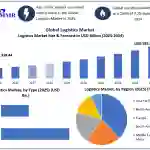
According to Maximize Market Research, the global logistics market was valued at USD 318.44 billion in 2025 and is projected to reach approximately USD 518.08 billion by 2032, growing at a compound annual growth rate (CAGR) of 7.2% during the forecast period from 2026 to 2032.
The market's expansion is supported by increasing e-commerce activity, growing international trade, and rising demand for third-party logistics services. Businesses are outsourcing transportation, warehousing, and distribution activities to specialized providers to improve efficiency and focus on their core operations.
Furthermore, investments in transportation infrastructure, logistics parks, distribution centres, and digital supply chain systems are strengthening market growth. The increasing movement of pharmaceutical products, food, electronics, and industrial materials is also creating opportunities for specialized logistics services.
Key Market Segmentation
The logistics market is segmented by services, type, business model, operation, mode of transport, category, usage, end use, and region.
By service, the market includes transportation services, warehousing and distribution, freight forwarding, inventory management, value-added logistics, and integration and consulting services. Transportation services play an essential role in moving products between manufacturers, distributors, retailers, and consumers.
By type, the market covers forward logistics and reverse logistics. Forward logistics involves moving products to customers, whereas reverse logistics manages returns, recycling, and product recovery.
By business model, the market includes first-party logistics (1PL), second-party logistics (2PL), third-party logistics (3PL), fourth-party logistics (4PL), and fifth-party logistics (5PL). Third-party logistics providers are gaining importance as businesses increasingly outsource supply chain operations.
By transportation mode, the market includes roadways, railways, airways, and waterways. Road transport supports flexible deliveries, railways provide cost-effective bulk transportation, airways enable faster deliveries, and waterways facilitate international cargo movement.
By operation, the market includes domestic and international logistics. The market also serves business-to-business (B2B) and business-to-consumer (B2C) customers across healthcare, manufacturing, retail, telecommunications, and other industries.
Growth Drivers
The rapid expansion of e-commerce is a major driver of the logistics market. Online retailers require efficient warehousing, order processing, packaging, and last-mile delivery services to meet customer expectations. Increasing online shopping is therefore encouraging logistics companies to expand their distribution networks.
Globalization and international trade are also supporting market growth. Manufacturers depend on logistics providers to transport raw materials and finished products across countries. Efficient freight forwarding and customs management are essential for maintaining reliable international supply chains.
Technological advancements are another important growth factor. Automation, artificial intelligence (AI), and Internet of Things (IoT) technologies help companies optimize delivery routes, monitor shipments, and manage inventory. Additionally, demand for temperature-controlled transportation is increasing in the pharmaceutical and food industries.
Emerging Trends
Digital transformation is reshaping the logistics industry. AI-powered route optimization, predictive analytics, and automated inventory management are helping companies improve productivity and reduce delays. IoT-enabled tracking systems provide real-time information about shipment locations and cargo conditions.
Warehouse automation is another significant trend. Robotics, automated sorting systems, and warehouse management software are improving order accuracy and operational efficiency. Digital freight platforms are also connecting shippers with carriers, simplifying freight booking and increasing transparency.
Sustainability is becoming increasingly important. Logistics providers are exploring electric delivery vehicles, fuel-efficient transportation, optimized delivery routes, and energy-efficient warehouses to reduce environmental impact. The growth of reverse logistics and sustainable packaging is further supporting environmentally responsible supply chain practices.
Regional Analysis
Asia Pacific is expected to dominate the global logistics market, supported by expanding e-commerce, manufacturing activity, international trade, and infrastructure investment. China, India, Japan, and Southeast Asian countries are important markets due to increasing consumer demand and the development of transportation and distribution networks.
North America represents a significant market because of its established logistics infrastructure, advanced warehouse automation, and strong demand for e-commerce fulfilment. The United States remains an important centre for domestic freight, third-party logistics, and technology-enabled supply chain services.
Europe benefits from extensive road and rail networks, established freight forwarding companies, and cross-border trade. Investments in sustainable transportation and digital logistics are supporting regional development.
Meanwhile, the Middle East and Africa are benefiting from investments in ports, airports, logistics hubs, and international trade corridors. South America is also experiencing opportunities through expanding retail distribution, agricultural exports, and infrastructure improvements.
Competitive Landscape
The global logistics market is highly competitive, with companies focusing on service reliability, international network expansion, technological innovation, and cost efficiency. Leading providers are investing in automated facilities, digital tracking platforms, and integrated transportation services to strengthen their market positions.
Key players identified by Maximize Market Research include DHL, Kuehne + Nagel, DSV A/S, DB Schenker, CEVA Logistics, A.P. Moller–Maersk, C.H. Robinson Worldwide, UPS Supply Chain Solutions, Expeditors International, Sinotrans Limited, GXO Logistics, and DP World Logistics.
In India, companies such as Delhivery, Blue Dart Express, Mahindra Logistics, Allcargo Logistics, and Safexpress contribute to the competitive landscape. Market participants are expanding their service portfolios, forming strategic partnerships, and adopting automation to meet changing customer requirements.
Download Free PDF Brochure@https://www.maximizemarketresearch.com/request-sample/94795/
Recent Developments
The logistics industry continues to invest in digitalization, warehouse infrastructure, and regional expansion.
In 2025, DHL Group announced a EUR 500 million investment in the Middle East for the 2024–2030 period to strengthen logistics capabilities, including express delivery, freight, and warehousing.
In 2025, Kuehne + Nagel launched an air logistics gateway in Bengaluru, India, to enhance cross-border logistics capacity and support sectors such as healthcare, technology, and automotive.
In 2026, CEVA Logistics opened an e-commerce warehouse in Dubai to expand fulfilment capabilities and support growing regional online retail demand.
These developments highlight the importance of strategic infrastructure investment, regional distribution networks, and technology-enabled logistics services.
Future Outlook
The logistics market is expected to maintain strong growth as e-commerce, international trade, and supply chain digitalization continue to expand. Investments in AI, robotics, real-time tracking, and integrated logistics platforms will help companies improve operational efficiency and delivery performance.
The adoption of multimodal transportation, electric delivery fleets, and automated warehouses is expected to create new business opportunities. Demand for specialized services, including cold chain logistics and reverse logistics, will also increase as industries seek reliable and flexible distribution solutions.
However, rising fuel prices, labour costs, infrastructure limitations, and supply chain disruptions remain significant challenges. Logistics providers that prioritize innovation, sustainability, and customer satisfaction will be better positioned to remain competitive.
For full access to the comprehensive strategic report, visit:https://www.maximizemarketresearch.com/market-report/global-logistics-market/94795/
Conclusion
The global logistics market is experiencing significant growth, driven by e-commerce expansion, international trade, technological advancements, and increasing demand for efficient supply chain management. With the market projected to grow from USD 318.44 billion in 2025 to USD 518.08 billion by 2032, logistics services will remain essential to global economic activity.
Digital transformation, warehouse automation, sustainable transportation, and integrated supply chain solutions are expected to shape the industry's future. Companies that invest in advanced technologies, expand their distribution networks, and improve operational efficiency can capitalize on emerging opportunities across global markets.
About Maximize Market Research
Maximize Market Research is a multifaceted market research and consulting company with professionals from several industries. Some of the industries we cover include medical devices, pharmaceutical manufacturers, science and engineering, electronic components, industrial equipment, technology and communication, cars and automobiles, chemical products and substances, general merchandise, beverages, personal care, and automated systems. To mention a few, we provide market-verified industry estimations, technical trend analysis, crucial market research, strategic advice, competition analysis, production and demand analysis, and client impact studies.
Contact Maximize Market Research
3rd Floor, Navale IT Park, Phase 2
Pune Bangalore Highway, Narhe,
Pune, Maharashtra 411041, India
sales@maximizemarketresearch.com
+91 96071 95908, +91 9607365656