

North America is emerging as a major hub for the adoption of advanced agricultural machinery as farmers increasingly turn to automation, precision technologies, artificial intelligence, robotics, and connected equipment to improve productivity. The US, in particular, has a highly mechanized agricultural sector and large-scale commercial farms that provide a strong environment for deploying autonomous tractors, smart planting systems, precision sprayers, robotic equipment, and connected farm-management platforms. Growing pressure to improve operational efficiency while addressing labor availability and rising input costs is accelerating the transition toward intelligent agricultural equipment.
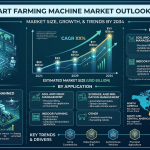
The global Smart Farming Machine Market Size was valued at US$276.02 million in 2025 and is projected to reach US$695.47 million by 2034, registering a CAGR of 10.81% from 2026 to 2034. Although these figures represent the global opportunity, North America is an important regional market supported by high agricultural mechanization, technology readiness, precision farming adoption, and the presence of major agricultural machinery manufacturers. The addressable opportunity for the global industry is estimated at US$4,297.56 million during 2026–2034.
Download Sample PDF: https://www.theinsightpartners.com/sample/TIPRE00017058
US Labor Availability Accelerates Agricultural Automation
Labor availability is one of the strongest drivers for smart farming machinery adoption in the US. Agricultural operations frequently operate within narrow planting, spraying, and harvesting windows, making access to skilled workers particularly important. Labor shortages can create operational bottlenecks, particularly for labor-intensive specialty crops.
The US Department of Agriculture's National Institute of Food and Agriculture highlights labor shortages, rising competition, quality requirements, and sustainability concerns as important challenges driving interest in agricultural automation, particularly for specialty crops.
This environment is encouraging US farmers to consider autonomous and semi-autonomous equipment capable of completing repetitive tasks with reduced operator involvement. Autonomous tractors, automated harvesting equipment, robotic systems, and machine-vision technologies can help farms make better use of available personnel while extending productive operating hours.
Precision Agriculture Strengthens Demand Across the US
Precision agriculture is another major growth driver throughout North America. US farms increasingly use GPS, high-accuracy positioning, sensors, field mapping, telematics, variable-rate technology, and digital farm-management platforms to improve field operations.
Modern smart machines can use field-level information to control seeding rates, fertilizer application, spraying, tillage depth, and harvesting activities. This approach enables farmers to respond to variations in soil conditions and crop requirements rather than treating an entire field uniformly.
For example, John Deere's US precision agriculture technologies include automated guidance, section control, variable-rate applications, field mapping, machine connectivity, and data-management capabilities. Its Operations Center platform connects field, machine, and operator data to support planning, monitoring, and analysis.
Such capabilities are particularly relevant to large US farms where improving efficiency across thousands of acres can generate substantial operational benefits.
Autonomous Tractors Transform US Farm Operations
Autonomous machinery is rapidly becoming one of the most visible developments in North American smart farming. US agricultural equipment manufacturers are investing heavily in autonomous tractors and implements that can navigate fields, identify obstacles, and perform operations with limited direct intervention.
John Deere, for instance, has introduced autonomous agricultural equipment using computer vision, cameras, artificial intelligence, and machine-learning technologies. Its autonomous tractor technology is designed to perform tillage operations while farmers monitor equipment remotely.
The ability to operate machinery during extended working periods is particularly valuable when weather conditions create narrow windows for field operations. Autonomous equipment can also allow farm personnel to focus on other activities while machines perform designated tasks.
As autonomous technologies become more commercially established, their adoption could expand from large row-crop farms into specialty agriculture and other applications requiring repetitive or time-sensitive fieldwork.
AI and Machine Vision Improve Input Efficiency
Artificial intelligence and machine vision are becoming increasingly important components of smart agricultural equipment in the US. Instead of simply automating machine movement, newer systems can identify crop and field conditions and adjust operations accordingly.
John Deere's See & Spray technology, for example, uses cameras, machine learning, and onboard computing to distinguish weeds from crops and selectively apply herbicides. The company states that its technology can reduce herbicide use by more than two-thirds under applicable crop and field conditions.
This type of targeted application demonstrates how smart machinery can support both productivity and resource efficiency. For US growers facing pressure to manage chemical costs and improve sustainability, intelligent spraying and precision application technologies can become increasingly valuable.
Connectivity Creates an Integrated Farming Ecosystem
Connected equipment is another important factor supporting North American adoption. Smart machines increasingly communicate with farm-management platforms, mobile devices, cloud systems, and other agricultural equipment.
Connected systems allow farmers to monitor machine location, field progress, operating conditions, productivity, and agronomic information remotely. John Deere's Operations Center, for example, enables users to plan fieldwork, monitor operations, analyze results, and manage connected machinery.
The development of connected ecosystems is expected to encourage farmers to view machinery as part of a broader digital infrastructure rather than as individual pieces of equipment. This creates opportunities for manufacturers offering integrated hardware, software, analytics, connectivity, and aftermarket technology upgrades.
Sustainability and Resource Optimization Support Adoption
Environmental considerations are also influencing smart farming equipment investments in North America. Farmers are seeking ways to improve the efficiency of fertilizer, pesticide, fuel, water, and other agricultural inputs while maintaining productivity.
Precision guidance can reduce unnecessary overlap during field operations, while automated application technologies can improve the accuracy of input placement. John Deere reports that its precision technologies support more accurate application, automated guidance, field mapping, and input management.
These capabilities align with the broader US focus on improving agricultural efficiency and sustainability. As environmental requirements and resource-management priorities develop, intelligent machinery is expected to play a growing role in farm-management strategies.
Top Players in the Smart Farming Machine Market
The competitive landscape includes major agricultural equipment manufacturers and technology providers with significant activities in North America. Key players include Deere & Company, AGCO Corporation, CNH Industrial N.V., Kubota Corporation, Trimble Inc., Topcon Positioning Systems, Mahindra & Mahindra Ltd., and Yanmar Holdings Co., Ltd.
In the US, Deere & Company is expanding autonomous machinery, precision upgrades, machine connectivity, computer vision, and AI-enabled agricultural technologies. The company also provides precision technology upgrades that can add advanced capabilities to existing farm equipment, potentially lowering the technology adoption barrier for farmers.
Competition is increasingly centered on autonomy, machine intelligence, connectivity, precision control, interoperability, and the ability to integrate equipment with digital farm-management platforms.
Future Outlook for North America
The outlook for the North American smart farming machine industry remains closely connected to the evolution of autonomous agriculture, AI, robotics, precision farming, and connected equipment. In the US, large-scale farms provide a strong application environment for technologies capable of improving productivity across extensive acreage.
Over the coming years, manufacturers are expected to expand autonomous capabilities across tractors, planters, sprayers, harvesters, and specialty-crop equipment. Machine vision and AI are also expected to support more targeted crop management, while connectivity will enable increasingly coordinated operations across entire farm fleets.
The US specialty-crop sector is also expected to provide opportunities for automation as producers address labor shortages and quality requirements. USDA NIFA-supported research is actively examining automation technologies for specialty crops, including sensor-based systems and automated approaches for improving growing, harvesting, and processing efficiency.
Globally, the Smart Farming Machine Market is projected to grow from US$276.02 million in 2025 to US$695.47 million by 2034 at a CAGR of 10.81% during 2026–2034. North America's technological infrastructure, established agricultural machinery ecosystem, and strong adoption of precision agriculture are expected to make the region an important contributor to this expansion.
About The Insight Partners
The Insight Partners is a globally recognized market research and consulting firm providing reliable and actionable insights across technology, business, and industry sectors. The company delivers research and strategic intelligence covering emerging technologies, industry trends, competitive landscapes, and growth opportunities.
Contact Us
The Insight Partners
Email: sales@theinsightpartners.com
Phone: +1-646-491-9876
Website: https://www.theinsightpartners.com
Related Reports -
Submarine Fiber Cable Market Demand, Share & Growth by 2034
Aircraft Wiring Harness Market Dynamics and Trends by 2030
SCADA Oil and Gas Market Size, Trends & Growth by 2034