
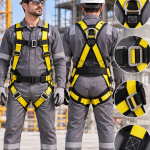

Working at height is a regular requirement in construction, maintenance, industrial facilities, warehouses, and a variety of other settings. While operating above ground, the risk of falling must never be overlooked. This is why organizations utilize fall protection systems to keep their employees safe.
There are two key approaches: fall arrest and fall restraint. Although they are intended to safeguard workers from falls, they function in various ways. Understanding the distinction can assist organizations in selecting the appropriate equipment, including a proper full body harness, for various work situations.
What is Fall Restraint?
A fall restraint is intended to prevent a worker from reaching a position where they could fall. Rather than allowing a fall and then arresting it, the system limits the worker's movement.
For example, a worker working near an unprotected roof edge may use a restraint device that restricts their movement. The system may contain a full body harness, a connecting device, and a suitable anchor point.
The main premise is straightforward: keep the worker from approaching the fall hazard in the first place. Fall restraints are especially effective when the work area allows employees to do their responsibilities without having to approach the edge.
What is Fall Arrest?
Fall arrest is intended to stop a worker after a fall has occurred. Unlike restraint devices, it does not always keep the worker from reaching the edge or entering an area where a fall could occur.
A common fall arrest system may contain a full body harness, lanyard or self-retracting lifeline, energy absorber, connectors, and a suitable anchor point.
If a worker falls, the system is intended to minimize the fall and lower the forces imparted to the worker when correctly selected and utilized.
Because a fall arrest system permits a fall to occur, proper preparation is required. Anchor location, fall distance, equipment length, energy absorption, and clearance below the worker are all important factors to consider.
Full Body Harness in Fall Restraint
A full-body harness can be an important part of a fall protection system. It distributes forces to the proper parts of the body and provides connections for relevant equipment.
In a restraint application, the connecting equipment is set up to restrict the worker's movement. The idea is to keep the worker away from areas where they could fall.
However, not every harness or connector configuration is necessarily appropriate for restraint. Equipment should always be selected and used in accordance with the manufacturer's recommendations as well as the overall system requirements.
Full Body Harness for Fall Arrest
In a fall arrest system, the full body harness connects the worker to the apparatus. If you fall, the harness distributes the arrest forces across your body rather than focusing them at one location.
A fall arrest device must be carefully developed because the worker may face enormous forces during a fall. When properly deployed, energy-absorbing devices can help to minimize these forces.
The harness, lanyard, connectors, anchor point, and other components should be compliant and appropriate for their intended use.
Key Differences Between Fall Arrest and Fall Restraint
The key distinction is what happens before a worker falls.
- Fall restraint: The system is intended to keep the worker from encountering the fall hazard.
- Fall arrest: The mechanism is intended to stop a fall once it begins.
This distinction is critical when evaluating a workplace. A suitable restraint system that keeps workers away from the edge may be desirable because it eliminates the risk of a fall.
Where workers must access areas where a fall could occur, a properly constructed fall arrest system may be required.
How to Select the Right System
The decision between restraint and arrest begins with a workplace risk assessment. Employers should think about the task being done, the height, access needs, accessible anchor points, worker movement, and potential fall hazards.
The system should also consider rescue plans. In a fall arrest situation, a worker may stay hung in their harness following the fall, making a suitable rescue process an essential component of the overall safety plan.
Workers should be trained on how to properly examine, wear, adjust, connect, and use their full body harness.
Importance of Inspection and Maintenance
Whether the harness is employed in a restraint or arrest system, regular inspection is required. Before usage, employees should inspect the webbing, stitching, buckles, D-rings, labels, and other components for evident damage or excessive wear.
Equipment that has been involved in a fall should be removed from service and treated according to the manufacturer's guidelines. Proper storage and maintenance can also help to maintain equipment function.
Final Thoughts
Fall restraint and fall arrest have different aims, although both can be effective in safeguarding workers at heights. A full body harness can be utilized as part of either type of system as long as it is adequate for the application and connected to compatible equipment.
The ideal method is to avoid a fall whenever feasible. When fall arrest is required, the system should be carefully chosen, inspected, and used, with adequate training and rescue planning.
Understanding these distinctions enables businesses and employees to make safer decisions and implement more effective fall protection strategies.