
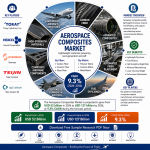



August 27, 2026 — The global aerospace composites market is estimated at USD 52 billion in 2026 and is projected to reach USD 127 billion by 2036, expanding at a 9.3% CAGR during 2026–2036, according to Fact.MR. The market was valued at USD 48 billion in 2025, with the forecast indicating USD 75 billion in new value between 2026 and 2036.
Aircraft makers are using more composites to reduce structural weight and improve fuel efficiency. Composite materials are replacing conventional metal components across aircraft platforms. Commercial aircraft production is a major source of demand, while defense modernization is also increasing the use of advanced structural materials. At the same time, certification requirements and high processing costs remain barriers to faster adoption.
Get detailed market forecasts, competitive benchmarking, and pricing trends: https://www.factmr.com/connectus/sample?flag=S&rep_id=6509
Industry Proof Points
Recent company developments cited by Fact.MR show continued investment across the aerospace composite supply chain. Toray Industries, February 20, 2025: Toray announced its participation at JEC World 2025, showcasing carbon fiber, thermoset composites, thermoplastic composites, and other composite technologies for aerospace and advanced mobility applications.
Hexcel, September 9, 2025: Hexcel announced an expanded Americas aerospace distribution network covering additional distributors. The company said the move would improve material access, geographic coverage, and technical support for aerospace customers.
Boeing, December 8, 2025: Boeing completed its acquisition of Spirit AeroSystems. Boeing said the transaction strengthened commercial production and supply-chain stability, while bringing major aerospace operations into the company. Fact.MR cites the transaction as an important development for the aerospace composites supply chain.
Key Numbers
- Market value, 2025:USD 48 billion
- Estimated market value, 2026:USD 52 billion
- Forecast value, 2036:USD 127 billion
- Forecast CAGR, 2026–2036:3%
- New value added, 2026–2036:USD 75 billion
Source: Fact.MR Aerospace Composites Market analysis.
Segment Breakdown
Carbon Fiber leads by fiber. Carbon Fiber accounts for 62.0% share in 2026, supported by its strength-to-weight performance and broad use in primary aircraft structures. Commercial aircraft programs are a major source of demand.
Polymer Matrix leads by matrix. Polymer Matrix represents 74.0% share in 2026. Low weight and processing flexibility support its use in structural and interior aerospace applications.
Exteriors lead by application. Exterior applications hold an estimated 58.0% share in 2026. Wings, fuselage sections, and other airframe structures require substantial composite content.
AFP/ATL leads by manufacturing process. Automated Fiber Placement and Automated Tape Laying account for 39.0% share in 2026. Automation supports manufacturing precision and production consistency.
Commercial Aircraft lead by aircraft type. Commercial Aircraft contribute 54.0% share in 2026, supported by aircraft deliveries and greater composite use in newer platforms.
Country Growth Outlook
- India:2% CAGR
- China:6% CAGR
- United Arab Emirates:8% CAGR
- United States:7% CAGR
- Germany:3% CAGR
- France:0% CAGR
Source: Fact.MR analysis based on aircraft production trends, aerospace manufacturing activity, and industry interviews.
India records the fastest growth among the countries assessed, with an 11.2% CAGR. Aerospace manufacturing investment and aircraft component production support demand. China follows at 10.6% CAGR, supported by domestic aircraft development. The UAE is forecast to grow at 9.8% CAGR, while the United States, Germany, and France are projected to expand at 8.7%, 8.3%, and 8.0%, respectively.
Competitive Landscape
Fact.MR identifies Toray Industries, Inc., Hexcel Corporation, Syensqo, Teijin Limited, and SGL Carbon SE as key players. Competition centers on material performance, aerospace certifications, manufacturing capacity, supply reliability, technical expertise, and long-term relationships with aircraft manufacturers and tier suppliers.
Company-level market shares are not disclosed on the Fact.MR page. Therefore, no company share percentages are stated here.
Analyst View
Shambhu Nath Jha, Principal Consultant at Fact.MR, states: “Market demand will be driven by aircraft production expansion and higher composite content per platform. Organizations aligned with aerospace manufacturing programs are positioned to strengthen market presence.”
For manufacturers, the outlook points to opportunities in production capacity, automated composite processing, and supply-chain availability. Distributors can benefit by strengthening relationships with aerospace component suppliers. Aircraft manufacturers can focus on automation to improve production efficiency.
Frequently Asked Questions
How large is the aerospace composites market in 2026?
Fact.MR estimates the market at USD 52 billion in 2026.
What will the aerospace composites market be worth in 2036?
The market is projected to reach USD 127 billion by 2036.
What is the aerospace composites market CAGR?
Fact.MR projects a 9.3% CAGR from 2026 to 2036.
Which aerospace composite segment leads in 2026?
Carbon Fiber leads the fiber segment with 62.0% share, while Polymer Matrix leads the matrix segment with 74.0% share.
Which country has the fastest projected growth?
India is projected to record the highest country CAGR at 11.2% through 2036.
Top Report
https://londonsocialgram.com/blogs/25005/Nicotine-Pouches-Market-Growth-Set-to-Reach-USD-89-9
https://sportivo.network/blogs/254468/Nicotine-Pouches-Market-Heads-Toward-USD-89-9-Billion-by
https://ontoplist.in.net/article/nicotine-pouches-market-value-set-to-hit-usd-899-billion-by-2036
https://picktu.in.net/article/nicotine-pouches-market-on-track-to-reach-usd-899-billion-by-2036
About Fact.MR: Fact.MR is a market research and consulting company providing market intelligence, forecasts, industry analysis, and strategic insights for businesses and decision-makers.